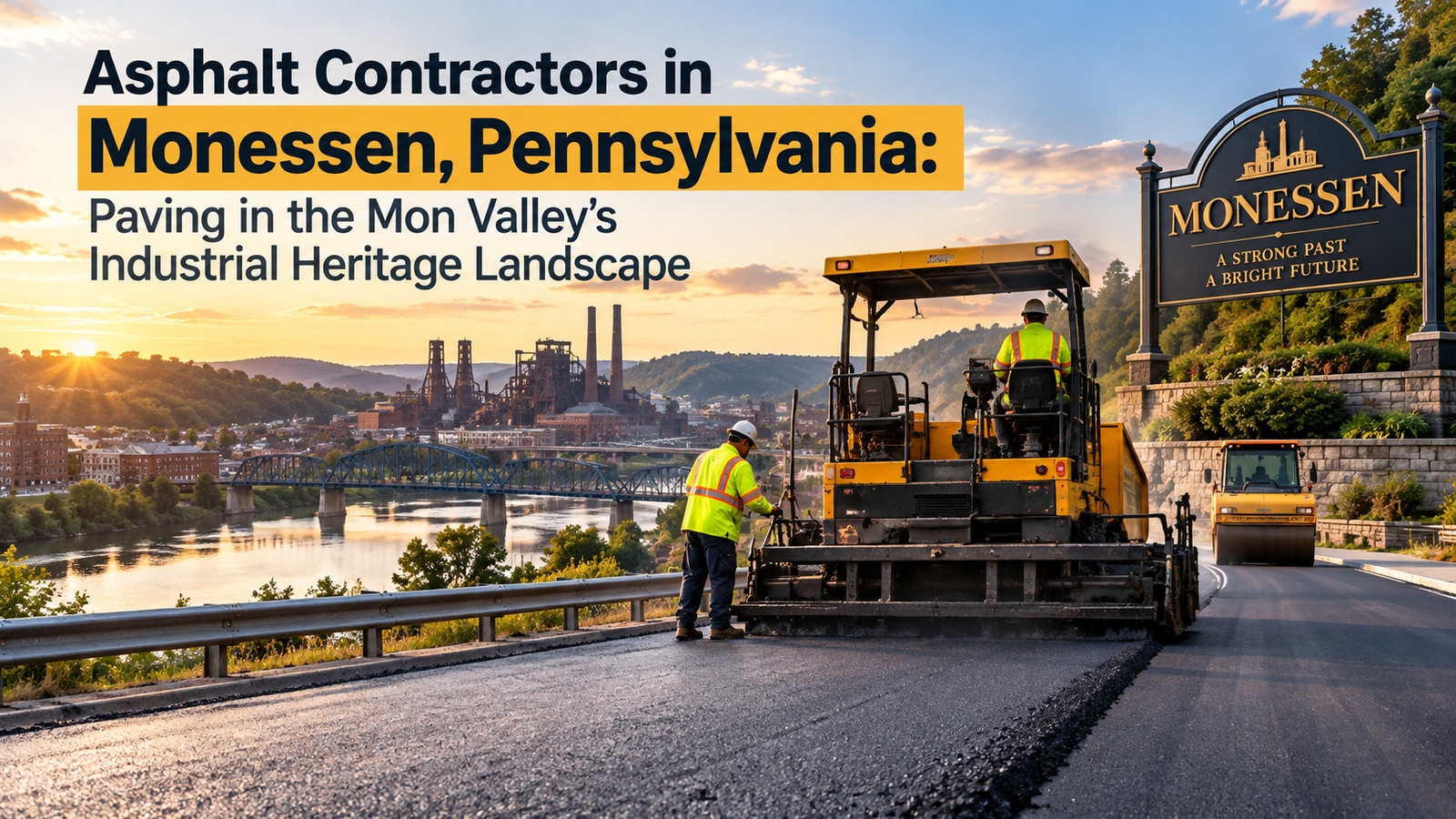
Monessen is a city in Westmoreland County situated on the west bank of the Monongahela River, about 28 miles south of Pittsburgh. Like many communities in the Mon Valley, Monessen’s history is defined by the steel industry that shaped the region the Monessen Steel Mill operated here through much of the twentieth century, and the physical landscape of the city bears the marks of that industrial legacy. Today Monessen is a community of roughly 7,500 people navigating the post-industrial transition that has reshaped much of southwestern Pennsylvania, with a mix of established residential neighborhoods, commercial properties along Donner Avenue, and a downtown working toward revitalization. For the homeowners, commercial property managers, and business owners throughout Monessen and the surrounding Westmoreland County communities, professional Asphalt Contractor Monessen paving is a recurring infrastructure need shaped by the Mon Valley’s specific climate, terrain, and built environment.
The Mon Valley Climate and Its Effect on Asphalt in Monessen
Monessen sits in the Monongahela River valley, and like all valley communities in southwestern Pennsylvania, it experiences the thermal inversions and cold-air pooling that characterize river valley climates. Cold air drains downhill and settles in valley floors, meaning that Monessen’s streets and driveways experience slightly more frequent and harder freezes than the surrounding ridgetop communities a climate dynamic that directly affects pavement performance. The river valley setting also creates fog and high-humidity conditions that keep pavement surfaces wet longer than in more exposed locations, increasing the duration of water exposure that accelerates surface oxidation and water infiltration.
Western Pennsylvania’s freeze-thaw cycle is the dominant pavement stress factor throughout the Mon Valley. Monessen experiences the typical western PA winter pattern of temperatures that cycle repeatedly through the 32-degree threshold freezing overnight, thawing by afternoon with 30 to 50 or more of these transitions over the course of a winter season. Each transition is a damage event for any pavement surface that has open cracks allowing water entry. The practical result is visible every spring on Monessen’s residential streets: new pothole formations that didn’t exist in November, widened cracks that were hairline in October, and the surface deterioration that accumulates from a season of hydraulic ice-expansion damage.
Monessen’s soils, like much of the Mon Valley, contain substantial clay content developed from the weathering of the underlying shale and siltstone bedrock and from glacial deposition. This clay-heavy subsoil expands when wet and shrinks when dry, creating a subgrade that moves seasonally and imposes that movement on any pavement built over it. Driveways and parking lots on clay-heavy subgrade in Monessen will develop reflective cracking driven by subgrade movement even on surfaces that are otherwise well-maintained, particularly along the joints between paved areas and adjacent concrete or along longitudinal construction joints in the asphalt.
Residential Paving in Monessen’s Neighborhood Landscape
Monessen’s residential neighborhoods step up the hillsides from the river bottom in the characteristic stacked-block pattern of Mon Valley communities tight urban lots on the valley floor giving way to steeper hillside properties as elevation increases. This terrain creates a range of residential paving scenarios that asphalt contractors working in Monessen must be prepared for.
In the older hillside neighborhoods where Monessen’s residential character is strongest, many properties have driveways that are steep, narrow, and constrained by the lot configurations that were established when the community was developed in the early to mid-twentieth century. Paving these driveways requires equipment that can maneuver in tight spaces, crew experience with hillside paving techniques, and attention to drainage design that prevents water from sheeting down the driveway surface at velocities that cause erosion at the base of the grade.
The age of Monessen’s housing stock also means that many residential driveways are at or past their functional lifespan. A driveway that was original to a 1960s or 1970s home has had decades of freeze-thaw cycling, seasonal clay movement, and traffic loading working against it. Many of these surfaces are beyond resurfacing the base condition has been compromised too thoroughly for an overlay to provide durable results and need full reconstruction to restore proper function. A contractor assessing a Monessen driveway that shows extensive alligator cracking, significant depression, or visible base material at the surface is looking at a reconstruction scope rather than a maintenance project.
For Monessen homeowners whose driveways still have sound base structure despite surface deterioration, mill-and-overlay resurfacing is a cost-effective rehabilitation that can extend the pavement’s useful life by 8 to 15 years. Identifying which condition category applies to a specific driveway requires a site assessment the presence or absence of alligator cracking, the feel of the surface under foot pressure in deteriorated areas, and the drainage history of the site all inform this assessment.
Commercial Paving Along Donner Avenue and Route 906
Monessen’s commercial activity concentrates along Donner Avenue and the Route 906 corridor, with a mix of retail, food service, and service businesses serving the local residential population and the broader Mon Valley commuter community. These commercial properties have parking lots and access areas that experience the specific deterioration patterns of urban commercial pavement: rutting in wheel paths from the repetitive traffic patterns of customers and delivery vehicles, pavement edge failures at curb lines and lot boundaries, and the accelerated aging that results from petroleum product contamination at fueling areas and dumpster pads.
Commercial paving maintenance for Monessen businesses follows the same fundamental cycle as elsewhere in western Pennsylvania sealcoating every 3 to 5 years, crack sealing annually before winter, re-striping as markings fade, and timely pothole repair before individual failures spread. What distinguishes Monessen’s commercial paving environment is the age of many of these properties: commercial buildings and their parking lots that were developed during Monessen’s steel-era peak in the mid-twentieth century may have pavement infrastructure that was never upgraded from its original installation. Original parking lots from that era, if still in use, are well past the reconstruction threshold and likely have base conditions that cannot support overlay.
Legacy Industrial Sites and Environmental Considerations in Monessen
Monessen’s industrial heritage creates a specific consideration for paving on or adjacent to former industrial properties. Sites that were used for steel manufacturing, coke processing, or related industrial activities may have subsurface contamination from legacy operations metals, polycyclic aromatic hydrocarbons, and other industrial byproducts that Pennsylvania’s Act 2 environmental cleanup program governs. Paving over or excavating near former industrial areas in Monessen may require assessment of subsurface conditions before ground-disturbing work begins. This is not a consideration for typical residential driveway work, but it is relevant for commercial or industrial development on Mon Valley properties with documented or suspected industrial history.
Pennsylvania’s Land Recycling and Environmental Remediation Standards Act (Act 2) provides a framework for the assessment and cleanup of contaminated properties, including establishing standards that are appropriate for different end uses. Properties being redeveloped with commercial paving over a former industrial site are subject to Act 2 oversight, and paving contractors working on these sites should be aware of any remediation status or deed restrictions that apply.
Common Questions About Asphalt Contractors in Monessen
Can a Monessen driveway with significant cracking be resurfaced, or does it need full replacement? The answer depends on the type of cracking. Longitudinal and transverse cracks driven by thermal cycling and clay subgrade movement are surface phenomena that can be crack-sealed and overlaid with good results if the base is still structurally sound. Alligator cracking the interconnected polygon pattern that signals fatigue failure in the base cannot be corrected by overlay. A physical assessment of the surface under foot pressure in the affected areas (soft or spongy = base failure; firm = potentially resurfaceable) combined with visual identification of the crack pattern is the starting point for this determination.
How much does freeze-thaw cycling specifically affect paving timelines in Monessen? In practice, the window between when the ground has thawed adequately for paving to begin in spring and when cold weather makes late-fall paving risky runs from roughly late April to early November in the Mon Valley. The optimal window for quality paving work consistent temperatures above 50 degrees Fahrenheit for both ambient and ground runs from May through September. Crack sealing, which has a wider temperature tolerance than hot mix placement, can extend the maintenance season slightly earlier in spring and later in fall.
Do contractors in Monessen handle both driveways and commercial lots? Yes. Full-service asphalt contractors serving the Mon Valley typically handle both residential driveway work and commercial parking lots, bringing the same base preparation and quality standards to both scopes while adjusting pavement section thickness and mix specifications for the specific loading conditions of each application.